




Human rights management

Dimensão SASB
Rights of Indigenous PeoplesCódigo SASB
RR-FM-210a.2Setor SASB
Forest ManagementDimensão GRI
General DisclosuresDimensão GRI
Material TopicsCódigo GRI
2-23Código GRI
2-25Código GRI
3-3Código GRI
2-24The Brazilian forestry sector, particularly its planted-forest-based production chain, is vital to the country's economic development and to generating direct and indirect jobs. Recognized certifications such as FSC and PEFC establish rigorous standards to protect human rights in forestry. These standards include banning child and forced labor, ensuring safe working conditions, respecting the rights of Indigenous peoples and local communities, and promoting gender equality and non-discrimination. Despite the adoption of these certifications and ongoing technological and productivity improvements, the sector still has significant opportunities to enhance human rights practices across the entire value chain.
In this scenario, Suzano reaffirms its commitment to respecting and promoting human rights in all its activities, operations, and supply chains. We acknowledge our responsibility to uphold the civil, political, economic, social, cultural, collective, developmental, peace, and environmental rights of all individuals with whom we engage or whom may be affected by our activities.
To this end, we consistently enhance the integration of human rights risk management into our corporate practices and implement measures to prevent, reduce, and address adverse impacts, in accordance with the United Nations Guiding Principles on Business and Human Rights (UNGPs).
As a member of the UN Global Compact, Suzano pledges to support and uphold internationally recognized human rights and to avoid any involvement in violations. Our commitments are rooted in existing and evolving regulations and international standards, including the UN Assembly's International Bill of Human Rights, the International Labor Organization's (ILO) Declaration on Fundamental Principles and Rights at Work, and its eight Fundamental Conventions. We also adhere to other globally recognized guidelines, such as ILO Convention 169 for Indigenous and Tribal Peoples, the Voluntary Principles on Human Rights and Security (VPSHR), the OECD Guidelines for Multinational Enterprises, and more recent regulations such as the Corporate Sustainability Due Diligence Directive (CSDDD) and the EU Regulation on Deforestation-Free Products (EUDR).
We prioritize compliance with all relevant national and international regulations in every country where we operate, and we aim to exceed legal standards by establishing a governance structure focused solely on human rights. This structure includes internal experts, interdisciplinary technical teams, and engagement with senior management, ensuring that human rights are embedded in our sustainability strategies and business decisions.
Recently, Suzano has enhanced its human rights due diligence processes by expanding risk analysis and monitoring in rural regions, establishing a formal remediation mechanism, and strengthening its listening and support channels. The company also engages with Indigenous and traditional communities and peoples, provides training for partners and suppliers, and runs programs focused on preventing gender-based violence and promoting decent work practices.
Furthermore, Suzano is dedicated to advancing human rights by enhancing the positive effects of its activities and taking a leading role in transforming its supply chain and society.
- Voluntary commitments, forums, and partnerships
By the end of 2024, Suzano, working with the Global Compact - Brazil Network and the International Labor Organization (ILO), led an unprecedented sector initiative to promote best practices in Human Rights Due Diligence (HRDD) among forestry companies.
The initiative integrates active listening with direct assistance to rural workers, enhancing the sector's ability to promote decent work and prevent human rights abuses.
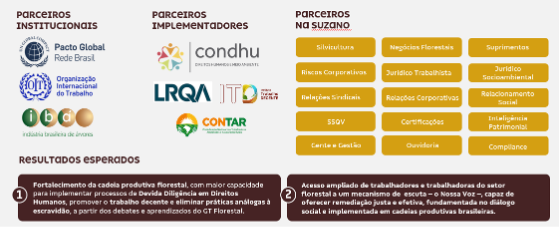
The expected results include:
- Enhancing the forestry production chain by implementing consistent HRDD processes, promoting decent work, and eradicating slavery-like labor practices, guided by discussions and insights from the Forestry Working Group (WG).
- Expanding access to listening and remediation mechanisms through Nossa Voz, providing effective responses rooted in social dialogue—creating a model that can be replicated across Brazilian production chains.
Forestry Working Group (WG) on Human Rights
The Forestry WG, launched in November 2024, is coordinated by the UN Global Compact - Brazil Network, with support from the ILO and active leadership from Suzano. It serves as a permanent platform for sector collaboration, uniting companies and organizations to enhance human rights and decent work agenda within the forestry sector. The group's meetings feature technical training, discussion circles, and training sessions for senior management and both direct and indirect suppliers, fostering a collaborative environment for learning and developing solutions.
Its main objectives include developing a sector-specific Human Rights Due Diligence methodology, supporting the establishment of complaint mechanisms aligned with the UN Guiding Principles, consolidating recommendations and best practices, and collaboratively building the future Sectoral Pact for Social Sustainability and Decent Work.
Since the initiative's launch, significant progress has been made, including training 30 suppliers in Human Rights and Decent Work, educating 13 company representatives in HRDD, and hosting seven sectoral meetings with an average of 34 participants each. By 2026, the Sector Pact is anticipated to be released, outlining guidelines and impactful actions to bolster the social agenda and advance decent working conditions across the forestry sector.
Moreover, the companies in the Forestry WG receive support from the Ministry of Labor and Employment (MTE) via the Sustainable Work Program to train and qualify workers in areas related to decent work. This partnership underscores the company's dedication to human development, institutional strengthening, and fostering labor relations founded on respect and dignity.
Nossa Voz Florestal Project
Suzano is implementing Nossa Voz Florestal as a pilot in Bahia and Espírito Santo to promote social dialogue and reduce labor and human rights risks in the forestry sector. The initiative, developed collaboratively, involved consulting 61 workers to tailor the tool to their needs and providing training for 130 municipal civil servants. This effort enhances municipal capacity and fosters a stronger, more responsible production chain. In the initial phase, over 589 workers in Suzano's value chain received training in Nossa Voz.
Nossa Voz Florestal is a free, accessible, and independent grievance system that primarily operates via WhatsApp. It enables safe reporting of concerns and functions as an early warning tool to detect and address risks related to child labor, forced labor, and violations of freedom of association. Managed under the supervision of the International Labor Organization (ILO), this system supports Suzano's commitment to collaborative efforts, multi-sector initiatives, and strengthening of social dialogue, particularly with rural workers in remote areas, leased lands, and among forest suppliers.
The program involves contracted employees, third parties, protection network professionals, community residents, and local organizations. Its strategies encompass training multipliers, collaborating with reference institutions, fostering intersectoral coordination, linking existing territorial initiatives, and enhancing public services.
In 2025, the Agente do Bem Program carried out various actions and events, including:
- May Orange Campaign (all units), with more than 4,000 employees participating.
- Combating feminicide (MS), with mentoring and training for multipliers.
- Fight against child labor (MS) through mobilization efforts and training of multipliers.
- Driver's Day (MS, SP, BA, and MAPATOCE) involved 580 employees.
- August Lilac Campaign—Maria da Penha Law (all units), involving over 1,000 employees.
- Campaigns across all units to fight sexual exploitation and human trafficking.
- Internal Week for the Prevention of Work Accidents (MS).
- Todos Por Elas campaign mobilized approximately 3,000 employees in Mato Grosso do Sul, with 1,800 in Três Lagoas and 1,200 in Ribas do Rio Pardo. It also involved a cooperation agreement between the Mato Grosso do Sul Court of Justice and the Ribas do Rio Pardo City Hall, aimed at protecting children, adolescents, and women.
The program includes multipliers who serve as strategic allies, spreading awareness of actions within their areas and units. They foster active listening and guide responding to current or potential rights violations. These multipliers are supported through training sessions, workshops, discussion groups, and internal communication channels.
Suzano is also a member of the Elos Platform of Brazil2Equal, an initiative of the International Finance Corporation (IFC) with the support of the Government of Japan, which aims to promote gender equality, diversity, and inclusion within the corporate sector and production chains. Through this engagement, the company collaborates on the development of strategic action plans and transformative practices that enhance women's roles in the transition economy, reinforce gender integration in climate strategies, and foster inclusive and resilient environments.
Suzano, in collaboration with Childhood Brasil, has organized campaigns and training sessions for both internal teams and external audiences. In Ribas do Rio Pardo (MS), this led to intersectoral coordination and the reinforcement of the local protection network, resulting in the establishment of Integrated Care Flows to safeguard children, adolescents, and women victims of violence. These flows are linked to the Municipal Council for the Rights of Children, Adolescents, and Women. The progress of this initiative is tracked through the “Suzano Social Programs” indicator.
The company also participated in the 19th Annual Na Mão Certa Meeting - Comunidade Na Mão Certa, a forum for learning and sharing best practices to combat the sexual exploitation and violence against children and adolescents on Brazilian highways. Since 2021, Suzano has been a signatory of the Business Pact against the Sexual Exploitation of Children and Adolescents on Brazilian Highways and has been recognized annually for following the actions and engagement plan. In 2025, this recognition came as a silver sponsor of the Na Mão Certa Program (PNMC), highlighting the company’s ongoing dedication and active involvement across various states. During the event, the company received a trophy and a certificate acknowledging its partnership and continuous commitment to this cause.
- Human Rights Governance
Suzano has established a comprehensive human rights governance framework embedded within its sustainability structure. A dedicated team, reporting to the Vice President of Sustainability, Communications, and Brand, focuses exclusively on human rights strategy and commitments. This team ensures that initiatives are executed effectively across the organization and remain consistent with relevant regulations and corporate commitments.
The governance framework features a dedicated team for the Human Rights Strategy, supported by a Human Rights Committee meeting bi-monthly. This committee, with representatives from over 16 departments, provides strategic guidance, oversees key decisions, and monitors the implementation of corrective actions to ensure management remains efficient, comprehensive, and aligned with international standards. Additionally, the Responsible Supplier Management Program is integrated into this structure. It is jointly overseen by the Sustainability and Procurement departments, which meet quarterly to review ESG efforts and progress across the value chain.
Departments and Operational Units are essential for implementing their assigned actions. They are responsible for taking corrective steps, utilizing human rights management tools, and consistently updating the Committee and the Executive Board on their progress. This coordination guarantees that human rights policies and practices are aligned throughout the organization.
During this process, dedicated monitoring tools are created to evaluate the effectiveness of actions, pinpoint gaps, and facilitate ongoing management review. This flexible approach enables Suzano to continually improve its strategy and enhance prevention, mitigation, and remediation activities.
The main goals of the governance framework are to enhance cross-departmental integration, ensure compliance with international laws and standards, continually improve internal processes to support regulatory adherence, mitigate risks, and enhance positive impacts throughout the value chain. Consequently, it fosters an organizational culture that places sustainability, decent work, and human rights as core pillars.
By 2025, Suzano aims to solidify its human rights governance by achieving key corporate goals and making steady advances in enhancing internal procedures, broadening due diligence efforts, and developing a risk management framework aligned with the UN Guiding Principles.
- Human Rights Due Diligence (HRDD)
To uphold its obligation to respect human rights per the UN Guiding Principles, Suzano has steadily enhanced its Human Rights Due Diligence (HRDD) process. This process is carried out through a comprehensive management system designed to identify, prevent, mitigate, and, if needed, address adverse impacts.
Since 2022, when we began our structured human rights due diligence journey, we have made continuous progress in integrating this issue into our operations and value chain. That year, with the support of a specialized consulting firm, we conducted our first mapping of human rights risks related to our activities. In 2024, we conducted a new assessment, also in collaboration with external human rights experts, to align our practices with emerging national and international legislation, including the Corporate Sustainability Due Diligence Directive (CSDDD).
This process led to revisions in our practices, updates to internal procedures, and enhanced human rights governance. In 2025, we built on this progress by implementing Suzano’s Human Rights Strategy, which includes over 165 action plans to direct our efforts in the short term (2025), medium term (2026–2027), and long term (2028–2030).
These plans underpin the Annual Human Rights Master Plan, detailing key deliverables, activities, responsible parties, and validators to ensure coherence, proper monitoring, and integration with corporate governance.
Our Human Rights Due Diligence (HRDD) process combines the Corporate Human Rights Policy with systematic risk identification, assessment, and management, with a particular focus on vulnerable groups. It includes mechanisms for social dialogue and engagement that promote meaningful stakeholder involvement, as well as complaint and remediation channels aligned with the effectiveness standards of the UNGPs. An integrated monitoring and reporting system supports transparency and ongoing improvement.
Public Commitment, Policies, and Procedures
Suzano reaffirms its commitment to respecting and promoting human rights throughout all operations and along its value chain through the Corporate Human Rights Policy, first created in 2020 and updated in 2025. This document embodies the company’s core values and its social responsibilities, consolidating the principles and guidelines that steer our practices.
The Policy also highlights the human rights most at risk of negative impacts from our activities, as identified through a risk assessment conducted by external experts and validated internally. The review process was collaborative and evidence-based, involving over 16 company departments and utilizing data triangulation, an approach that combines various sources and viewpoints to improve analysis consistency and support informed decision-making.
Among the key human rights issues highlighted are: ensuring decent working conditions in our operations and value chain; prevention of child labor, forced labor, and human trafficking; respect for the rights of Indigenous and traditional communities; protection of local communities, human rights defenders, as well as the right to health, a healthy environment, and ecosystem services; property security, land rights, and the rights of communities in the value chain.
The Policy and its updates received approval from the Vice Presidency. The document is accessible in the primary languages of the countries where Suzano operates, and the commitments extend to all operations, leadership, employees, and contractors both in Brazil and internationally. We anticipate that all of the company’s partners will uphold human rights in their business activities and adhere to the principles and guidelines outlined in this policy.
Additionally, Suzano maintains an Internal Human Rights Due Diligence Manual and is consistently working to embed its principles into core corporate documents, procedures, and processes. To support this initiative, a library has been created to compile 163 internal documents addressing key human rights issues, helping to standardize and reinforce management practices throughout the company.
Human Rights Risk and Impact Management
Suzano acknowledges that human rights impacts are inherent in the social and environmental risks associated with its activities. These impacts are regularly assessed throughout our operations and value chains.
The socio-environmental impact matrix forms a key part of this process. Updated yearly and created by multidisciplinary teams, the Social Aspects and Impacts Matrix use eight qualitative and quantitative criteria to identify, evaluate, and prioritize impacts. In 2024, this process was reviewed to include specific human rights methods and Frameworks, aligned with international standards.
This work is also guided by stakeholder engagement strategies, including monitoring initiatives such as the Operational Dialogue/In-Person Agenda for the community and ongoing assessments with suppliers and workers. These processes utilize tools such as the 'Relacione+' Stakeholder System, a relationship management platform that gathers feedback from the identification and assessment stages to inform the matrix.
The company’s Complaints Channel operates as an independent contractor-run entity that guarantees anonymity and confidentiality. Complaints are handled confidentially, with mechanisms to prevent retaliation for those who report issues. Additionally, the Operational Dialogue methodology identifies potential social and environmental risks in forestry, industrial, and port activities. This approach aims to provide ongoing feedback for the Social Aspects and Impacts Matrix. Through this process, we implement measures to prevent, reduce, correct, or address negative impacts on human rights, while also enhancing positive effects for society.
By 2025, Suzano enhanced its human rights risk management by creating a new assessment methodology developed with external experts. This method relies on data triangulation and international standards. It strengthens the process of identifying and prioritizing actual and potential risks by evaluating factors such as incidence, scale, scope, remediability, and likelihood.
The methodology was piloted at the Ribas do Rio Pardo Unit, where 21 institutional documents were reviewed and over 10 corporate processes were analyzed. This effort led to the identification and classification of 25 human rights risks aligned with international standards, operational types, and rights holders. Consequently, a 4x4 risk classification matrix, a replication guide, and a recommendations report were developed, forming the foundation for expanding the approach to other units. The methodology spans forestry, industrial, construction, logistics, and value chain activities, supported by a replication guide and recommendations report to facilitate its broader implementation.
Suzano incorporates the management of measures to reduce impacts on mapped human rights into the routines and responsibilities of various departments. This includes human resources practices, environmental management, eco-efficiency initiatives, procurement and supplier processes, and continuous stakeholder engagement. Our teams consistently identify and track social and environmental risks connected to human rights.
To prevent, mitigate, or address actual and potential impacts arising from its operations, Suzano implements measures in its Social Aspects and Impacts Matrix that match the significance of the impact. This ensures that suitable recommendations and actions are taken during activities, and that material considerations are incorporated into decision-making.
All incidents concerning the remediation and/or mitigation of human rights impacts on communities and stakeholders are handled in accordance with the guidelines outlined in the Stakeholder Incident Management Procedure and the Procedure for Identifying and Assessing Socio-Environmental Aspects and Impacts, as documented in Relacione+.
Our operations are evaluated annually by independent external auditors to ensure compliance with forest certification standards, which also cover human rights and ILO Core Principles related to our forestry activities. For more details, see the indicator “Total number and percentage of suppliers that underwent environmental and social assessment.”
Training and qualification
Suzano uses a structured training program to help all employees perform their roles safely and in accordance with the company’s human rights commitments. Our mandatory training system provides ongoing updates on workplace duties, responsibilities, and rights. Additionally, targeted initiatives enhance the integration of the UN Guiding Principles on Business and Human Rights into our operations.
A key part of this mandatory training is the Code of Ethics and Conduct, emphasizing that human rights are a core pillar of corporate responsibility. The Code directs behavior, decision-making, and relationships, emphasizing that respecting human rights is an individual and unwavering obligation. By systematically including this topic, the training ensures all employees recognize their responsibility to prevent negative impacts, foster safe and inclusive workplaces, and operate ethically.
Alongside this mandatory training, Suzano undertakes targeted awareness initiatives on human rights and due diligence. In 2025, 320 professionals received training on human rights due diligence processes and emerging international regulations. Additionally, we advanced education for teams involved in forest certification, emphasizing the social criteria of the FSC’s New Forest Stewardship Standard to foster alignment between voluntary and regulatory standards.
To enhance our decent work practices and support decision-making based on internationally recognized methods, we conducted six specialized workshops on living wages. These workshops were led by the Anker Research Institute (ARI), CEBRAP, and Social Accountability International (SAI), and involved teams from People & Management and Social Development.
Focusing on suppliers and third-party workers, we hosted the Social and Environmental Awareness Tour in 2025. This initiative, developed by the Procurement team, aimed to share best practices and concepts related to human rights and environmental governance. It reinforced Suzano’s strategic commitment to risk mitigation and to implement due diligence in human rights and decent work, while strengthening our relationships with suppliers. We introduced new support materials, including the updated Supplier Code of Conduct, the Human Rights Manual, and the Golden Rules, which now serve as key references across our entire value chain. The Tour traveled through ES, BA, MA, MS, and SP, engaging over 120 suppliers and more than 250 participants. Additionally, in collaboration with the UN Global Compact, the ILO, and IBÁ, we trained 30 sector suppliers on decent work topics, broadening the scope and impact of our human rights initiatives.
Learn more in the indicators: “Total number of training hours and total number and percentage of employees trained in human rights policies and practices,” “Responsible supplier management,” and “Security team trained in human rights policies or procedures, by type of operation.”
Regarding communication and reporting, Suzano disseminates pertinent data and information on its risk management and its human rights impacts through various channels, including the human rights management indicators on the Suzano Sustainability Center, the annual report, certifications, and the management plan for the company’s operations, all accessible via our website.
Channels for Dialogue and Mechanisms for Complaints and Redress
Suzano values transparency in its relationships with stakeholders and has implemented a formal process for receiving, assessing, responding to, and following up on communications regarding its activities and products.
We offer a Complaints Channel for both internal and external stakeholders, ensuring confidential and discreet handling of any concerns, including human rights issues. This channel covers, but is not limited to, violations of the Code of Ethics and Conduct, the Corporate Human Rights Policy, the Anti-Corruption Policy, the Public Information Security Policy, and the Diversity and Inclusion Policy. Reports can be submitted by calling 0800 771 4060 (Brazil), using the Contato Seguro app, or through the Contato Seguro website, which is accessible in all regions where the company operates.
Reports are handled via a computerized system supplied by a partner company. Once a report is received, an investigation typically begins and takes around 30 days. The findings are then sent to the appropriate departments, which review and determine corrective actions and plans.
The main report categories include inappropriate behavior, fraud, working conditions, labor issues, health and safety, and information security. After investigation, responses may involve warnings, suspensions, or terminations. Quarterly, data from the Complaints Channel is shared with the Conduct Management Committee, made up of senior leaders who advise decisions from investigations. More details are available at “Management of the Code of Ethics and Conduct.”
Suzano also employs various mechanisms for dialogue with stakeholders, which help inform its analysis of human rights impacts and risks:
- Operational Dialogue: a methodology designed to anticipate and prevent social risks in forestry, industrial, and port activities by engaging with communities, local leaders, and public authorities
- In-person meetings: regular sessions held between operational cycles to sustain dialogue and address key issues.
- Community listening and engagement: procedures to mitigate risks, foster long-term relationships, and tackle issues faced by traditional communities.
- Contact Us (communities and stakeholders): a toll-free 0800 communication channel available regionally across operations, which consolidates records in the Relacione+ system. This system manages reports from neighbors, local communities, and Indigenous and traditional communities, recording and monitoring all received communications.
- Floresta Viva Program: an initiative aimed at preventing and fighting forest fires, to safeguard biodiversity and local communities.
- Nossa Voz: Currently piloted in Bahia, this initiative by Suzano serves as a platform for dialogue, complaints, and redress for workers in remote regions, on leased lands, and at supplier sites. The channel is free, independent, and easily accessible, guaranteeing confidentiality and safeguards against retaliation, in line with the UN Guiding Principles.
Developed under the ILO's technical supervision, it acts as an early warning system to detect and address labor and human rights risks, supporting preventive and corrective measures. In 2025, feedback from 61 workers was collected to enhance the mechanism, resulting in improvements in accessibility, communication, and case management. This direct engagement with those affected strengthens the rights-holder-centered approach and reflects Suzano’s dedication to maintaining effective redress tools and ongoing progress.
Through Relacione+, all contacts and negotiations regarding the redress of losses and damages caused by Suzano’s activities are documented, strengthening the company’s commitment to protecting human rights and supporting impacted communities.
Suzano condemns any retaliation against people or groups who raise concerns about real or potential human rights issues. We foster an environment in which these rights holders feel secure voicing their concerns to the company’s representatives.
1.1. Major Human Rights Issues
Based on the results of our human rights due diligence processes and risk mapping, we have identified our key issues, those requiring the most attention and effort, in Suzano’s Human Rights Strategy. These issues guide the establishment and implementation of measures to mitigate adverse impacts.
Suzano is dedicated to adhering to the mitigation hierarchy to stop, reduce, repair, and address adverse impacts. This involves taking proactive measures, providing fair and balanced solutions, prioritizing consensus, and consulting with conciliation bodies when needed.
Besides acknowledging that our operations and value chain might pose human rights risks, we aim to be a force for positive change. The company has launched initiatives that support poverty reduction, improve education, foster diversity, equity, and inclusion, address the climate crisis, and promote ecological balance and biodiversity conservation.
We also uphold structured community engagement initiatives, training staff and partners, along with management processes and documentation that directly focus on human rights. Many of these efforts align with our main themes, helping to create shared value, strengthen our dedication to data transparency, and protect and advance human rights.
Using a structured human rights risk management process, which included internal assessments, external references, and expert input, we identified our main issues. This method allowed us to focus on the most significant impacts and establish priorities for prevention, mitigation, and remediation. Below are the key issues uncovered through this approach¹:
Decent Work in Operations and Supply Chain
Suzano is committed to ensuring decent, safe, and fair working conditions across its operations and value chain, aligning with ILO Conventions, its Code of Ethics and Conduct, and international human rights standards. This commitment involves zero tolerance for forced labor, human trafficking, debt bondage, child labor, excessive hours, degrading conditions, or any coercive practices.
We advocate for safe and healthy workplaces by prioritizing accident and occupational illness prevention, cultivating a safety culture, and encouraging ongoing reporting of incidents, risks, and improvement opportunities. Additionally, we uphold the right to freedom of association and collective bargaining, ensuring transparent and cooperative relationships with labor unions.
The company emphasizes its dedication to diversity, equity, and inclusion by fostering an environment free from discrimination and promoting respect and equal opportunities for all employees and contractors.
Suzano’s forestry operations span a broad area and involve interactions with local communities. The Sustainable Procurement Policy addresses human rights, while the Supplier Code of Conduct sets clear expectations and standards for partners, including specific requirements on human rights and environmental compliance. This ensures Suzano’s sustainability policy is integrated throughout its supply chain. In 2025, we introduced the Human Rights Manual and the Golden Rules e-book to promote understanding of human rights and socio-environmental impacts, further demonstrating Suzano’s dedication to its procurement partners.
Supplier categories are assessed for human rights and environmental risks. Potential suppliers first complete a self-assessment, then undergo a document and legal review to confirm their eligibility for contracting based on legal compliance.
Based on the risk level and the activity involved, the supplier may undergo assessments related to health, safety, and labor practices. For higher-risk categories, suppliers are evaluated on specific human rights concerns using tools that detect controversies and allegations of human rights violations. Additionally, some suppliers may be subject to external audits conducted by specialized firms. For more details, refer to the “Responsible Management of Suppliers” indicator.
Timber suppliers and other stakeholders are monitored through annual audits conducted by first-, second-, and third-party audits. These audits verify that forestry activities comply with relevant laws and uphold social and environmental standards required by FSC and PEFC forest certification standards, including FSC-STD-40-005, PEFC 2002:2020, and FSC National Risk Analysis (FSC-NRA-BR). Additionally, contractual clauses embody the company’s sustainability commitments.
The FSC-STD-40-005 standard, which applies to the receipt of non-certified wood labeled “controlled wood,” mandates the establishment of a due diligence system to identify and address risks. This includes concerns related to human rights and vulnerable groups, ensuring that materials from unacceptable sources are not accepted.
In 2025, Suzano, together with the Global Compact – Brazil Network and the International Labor Organization (ILO), and with strategic support from the Brazilian Tree Industry (IBÁ), took the lead in establishing the Forestry Working Group (WG). This group aims to foster decent work across the forestry sector by developing a sector-specific Human Rights Due Diligence (HRDD) methodology, training companies, sharing best practices, establishing complaint mechanisms aligned with the UN Guiding Principles (UNGPs), and collaboratively developing the future Sectoral Pact for Social Sustainability and Decent Work.
Learn more in the sections titled “Occupational Health and Safety Management,” “Labor Relations Management,” “Responsible Supplier Management,” and “Right to Freedom of Association and Collective Bargaining, as well as the risks of Child Labor and Forced or Slavery-Like Labor in Operations and Suppliers.
A Healthy Environment, Just Transition, and Ecosystem Services
Suzano acknowledges everyone’s right to a healthy environment and incorporates sustainability into its business approach. It is actively advancing in assessing socio-environmental impacts, dependencies, and risks. Guided by this understanding, our efforts focus on enhancing territorial resilience, conserving biodiversity, boosting water supply, and lowering emissions and waste. These initiatives align with our Climate Transition Action Plan (CTAP) and Zero Deforestation Policy.
We acknowledge the interconnectedness of nature, carbon, and human rights. As a result, we follow best practices for biodiversity conservation, enhance our understanding of how we impact and depend on nature and ecosystem services, and work to reduce water withdrawal while increasing water availability in key watersheds within our operational regions.
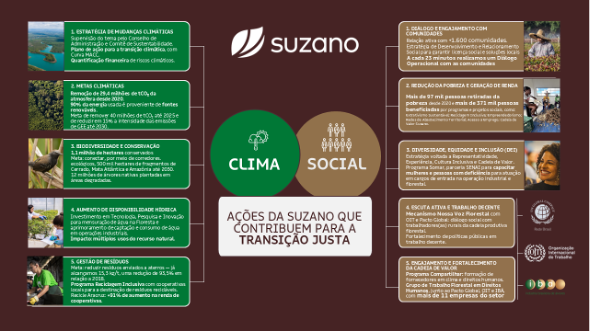
Recognizing that a fair and inclusive transition to a low-carbon economy must prioritize people and communities, especially the most vulnerable, Suzano implements a social development strategy in nearby areas. We have integrated Climate, Human Rights, Diversity, Equity, and Inclusion, and Social Development efforts to establish a unified corporate approach to Just Transition. By 2025, this approach was strengthened with the Climate Transition Action Plan (CTAP), which outlines the company's initiatives to cut direct and supply chain emissions, leverage clean technologies, increase process efficiency, and shift from fossil fuels to renewable energy. For more details, see “Suzano’s social programs” and “Climate change at Suzano”.
Local communities and human rights defenders
Engaging with surrounding communities serves two key purposes: preserving Suzano’s Social License to Operate and fostering social development. Establishing a mature, coherent, and consistent social relationship with local communities is vital for maintaining the Social License. To accomplish these objectives, continuous and transparent communication with local associations, cooperatives, NGOs, neighbors, labor unions, municipalities, state governments, and other companies is crucial. This approach helps strengthen our reputation and ensures the stability and ongoing success of our activities, demonstrating our dedication to sustainable and responsible management.
The company tracks both positive and negative social impacts stemming from its activities in local communities and implements suitable mitigation measures for each situation. Suzano’s social monitoring and evaluation plan aims to assess the effectiveness of its relationship strategies and socio-environmental investments, as well as to monitor and evaluate processes and actions designed to reduce social risks related to the company’s operations (including impacts and demands). These are outlined in the internal procedures and policies:
- Suzano's Corporate Human Rights Policy: consolidates Suzano’s commitment to uphold and promote human rights throughout all its operations and supply chain. It provides structured guidance for conducting thorough due diligence to identify, prevent, and minimize risks while enhancing positive impacts. The policy offers clear directives for all departments to align their actions with international human rights standards and responsible risk management. Additional information is available at “Corporate Human Rights Policy”.
- Identification and assessment of social aspects and impacts: this process outlines procedures and a management framework for identifying, evaluating, and classifying the socioeconomic and environmental aspects and impacts arising from Suzano’s activities. It also incorporates a mitigation hierarchy to prevent, reduce, repair, and/or remediate adverse impacts through management practices, socio-environmental investments, and ongoing control measures, integrated into the company’s operational management system. For more details, see “Social Impact Management”.
- Community and Neighbor Relations Management Manual: aims to establish Suzano’s guidelines and strategic approach for fostering social legitimacy. It emphasizes strengthening long-term interactions with local communities and integrating their interests into business operations. The relationships are founded on transparent dialogue, respect for human rights, and appreciation of economic, social, and cultural values. Additionally, they recognize the autonomy and leadership of all parties involved, aligning with our Corporate Human Rights Policy principles. For more information, see “Engagement Mechanisms” and “Suzano’s Social Programs."
Socio-environmental Investment and Donation Policy: At Suzano, investments in social and environmental initiatives, along with donations, are key strategic tools for generating shared value and fostering sustainable growth in the communities and regions where the company operates. These efforts are aligned with major global standards and principles, ensuring active and transparent stakeholder engagement, building trust, and supporting local, regional, and territorial development. The main strategic pillars include:
I. Strengthening community relationships: enhancing our social license via dialogue, participation, and respect for the rights of local, traditional, and Indigenous peoples.
II. Poverty alleviation: expanding income, health, and education through solutions and partnerships that foster social and economic inclusion.
III. Enhancing education: backing initiatives that guarantee access, retention, and learning opportunities for adolescents and young people.
IV. Operating with best environmental practices: fostering positive impacts, conserving biodiversity, and honoring traditional knowledge in land management.
V. Strengthen institutional relationships: establish transparent partnerships that incorporate due diligence principles and guarantee prior, free, and informed consultation and consent.
VI. Promote volunteering and citizenship: encourage volunteer initiatives that create shared value and strengthen respect for human rights. For additional information, see “Private Social Investment Management.”
Suzano proactively seeks to address harm without waiting for complaints and respects the affected party's right to choose solutions. More details are available under “Engagement mechanisms” and “Incident management.”
We have also adopted management systems, engagement procedures, and certifications designed to prevent and reduce adverse operational effects on local communities.
Indigenous peoples, Quilombolas, local and traditional communities
We respect and promote the human rights of local, Indigenous, and traditional communities located within the areas of influence of Suzano’s operations, in accordance with the implementation of the Social Relations strategy, in a culturally appropriate and ongoing manner, based on trust and mutual respect for rights and interests, in compliance with the principles established by internal procedures and policies that address economic, environmental, and sociocultural rights and interests. These are the internal procedures and policies:
- Identification and definition of High Conservation Value Areas (HCVAs) and Archaeological Sites: the process of identifying and delineating regions with exceptional environmental or social importance that require protection. Throughout Suzano’s operational zones, all areas classified as HCVs or Sites of Special Significance (SSS) are regularly monitored and safeguarded to maintain their social and environmental characteristics. An area is considered of high value if it exhibits one or more High Conservation Value attributes, such as:
- HCV1: areas with significant concentrations of biodiversity values (endemism, threatened species, biodiversity refuges);
- HVC2: extensive forest areas where viable populations of most or all natural species occur in natural patterns of distribution and abundance;
- HVC3: regions that are part of or include rare, threatened, or endangered ecosystems.
- HVC4: areas that deliver essential environmental services in critical situations, such as watershed protection and erosion control.
- HVC5: areas that meet indispensable and irreplaceable needs for the survival of interested and affected communities, whether local or traditional;
- HVC6: areas that meet the cultural needs (religious, folkloric, economic, and ecological) of interested or affected communities, whether local or traditional. Or, furthermore, areas that constitute paleontological, archaeological, historical, or religious, spiritual, or scenic heritage sites, legally or widely recognized in universal, national, state, municipal, or local social contexts;
- LES: a natural, anthropized, or infrastructure-equipped area used by communities for cultural, ecological, economic, and religious activities, situated within Suzano properties;
- Archaeological Sites: locations where human activities remain, whether from pre-colonial or historical periods, are found on the surface, underground, or submerged. These sites are subject to archaeological contextualization. For more information, see “High Conservation Value Area (HCVA).”
- Corporate Policy on Relations with Indigenous Peoples and Traditional Communities: Relations with Indigenous and traditional communities must be conducted in a culturally appropriate, ongoing manner, based on trust and mutual respect for rights and interests. The policy aims to establish the guidelines and general principles for relations with Indigenous peoples, quilombola communities, extractivists, artisanal fishers, and other traditional communities, to be applied in all of Suzano’s operations, as well as throughout its value chain (suppliers, customers, and other stakeholders), through:
- I. Recognition, appreciation, and respect for socio-environmental and cultural diversity;
- II. Recognition and respect for beliefs, customs, traditions, languages, social and political organization;
- III. Socio-environmental responsibility toward people and territories;
- IV. Recognition and respect for legal and customary land rights;
- V. Full promotion of socioeconomic and cultural rights;
- VI. Promotion of Free, Prior, and Informed Consultation (FPIC) processes, where applicable. Learn more at “Relationships with Indigenous and traditional Communities” and “Programs with Indigenous Communities”.
In 2025, the working group formed the previous year to tackle new regulations that kept progressing in integrating human rights into corporate strategies. Concurrently, we further developed our nature strategy, aligned with the framework of the Taskforce on Nature-related Financial Disclosures (TNFD), which includes guidelines for the human rights of Indigenous peoples and traditional communities.
We reaffirm our commitment to engaging with Indigenous peoples and traditional communities in an ethical, transparent, and culturally sensitive way. We uphold their right to self-identification and ensure our relationships, dialogue, and engagements align with the rights outlined in national laws and ILO Convention No. 169, including respecting their rights to access and use natural resources and assets.
Right to land
At Suzano, we prioritize respecting property rights, peaceful land use, and possession. Before starting land negotiations, we perform due diligence to evaluate social impacts on nearby communities and other potential risks. Our goal is to operate ethically, responsibly, and in harmony with local communities and their rights.
In forestry operations, we have implemented the Timber Procurement Policy, which requires that our plantations be established only in areas previously modified by human activity for other purposes, provided these conversions did not occur under our direct or indirect responsibility, supporting our commitment to zero deforestation. In this framework, our own lands and timber suppliers are recognized as key elements in our human rights agenda and are incorporated into certification management processes that oversee the entire supply chain.
Among the forestry certifications related to timber supply and forest product trade, we highlight Forest Stewardship and Chain of Custody, which are implemented by certification programs such as PEFC (Program for the Endorsement of Forest Certification) and FSC (Forest Stewardship Council®). These programs ensure good management practices and responsible sourcing across environmental, social, and ethical areas throughout the production process. The certifications cover forestry activities, from verifying compliance with environmental, economic, and social standards, such as Forest Stewardship, to product distribution via the chain of custody, which ensures traceability, Occupational Health and Safety, and labor standards. Responsible Forest Stewardship also encourages land title regularization and measures to prevent physical or economic displacement or land-related conflicts. All standards include a due diligence system to identify and manage human rights risks.
Every year, we perform internal audits to verify adherence to certification principles, indicators, and criteria, promoting ongoing enhancement in our operations. We also undergo external audits by third-party organizations, helping us prove compliance with requirements and spot areas for improvement or correction of non-compliant processes.
These processes include certifications, recertifications, and seal maintenance, showcasing Suzano’s dedication to sustainable practices. Find out more in “Land Use Management”.
We track controversies and allegations related to the lands we operate on and communicate our stance on these issues.
Property security
Suzano acknowledges that its security teams often engage with employees, service providers, and external stakeholders during the monitoring and safeguarding of our native and planted forests, along with our industrial and commercial facilities across our operating region.
Our actions are guided by the Voluntary Principles on Security and Human Rights (VPSHR), which offer guidance on the appropriate use of force and respecting human rights. We adhere to the laws of the countries where we operate, provide targeted training for our security teams, and have established mechanisms to monitor their behavior, including handling complaints and grievances. Each year, our property security teams undergo formal training on Suzano’s human rights policies or specific procedures for applying them. For more details, see “Security team trained in policies or procedures related to human rights, by type of operation”.
Note:
1. By establishing an in-house human rights team, Suzano has enhanced its understanding of key risks and has consequently revised its communication approach.